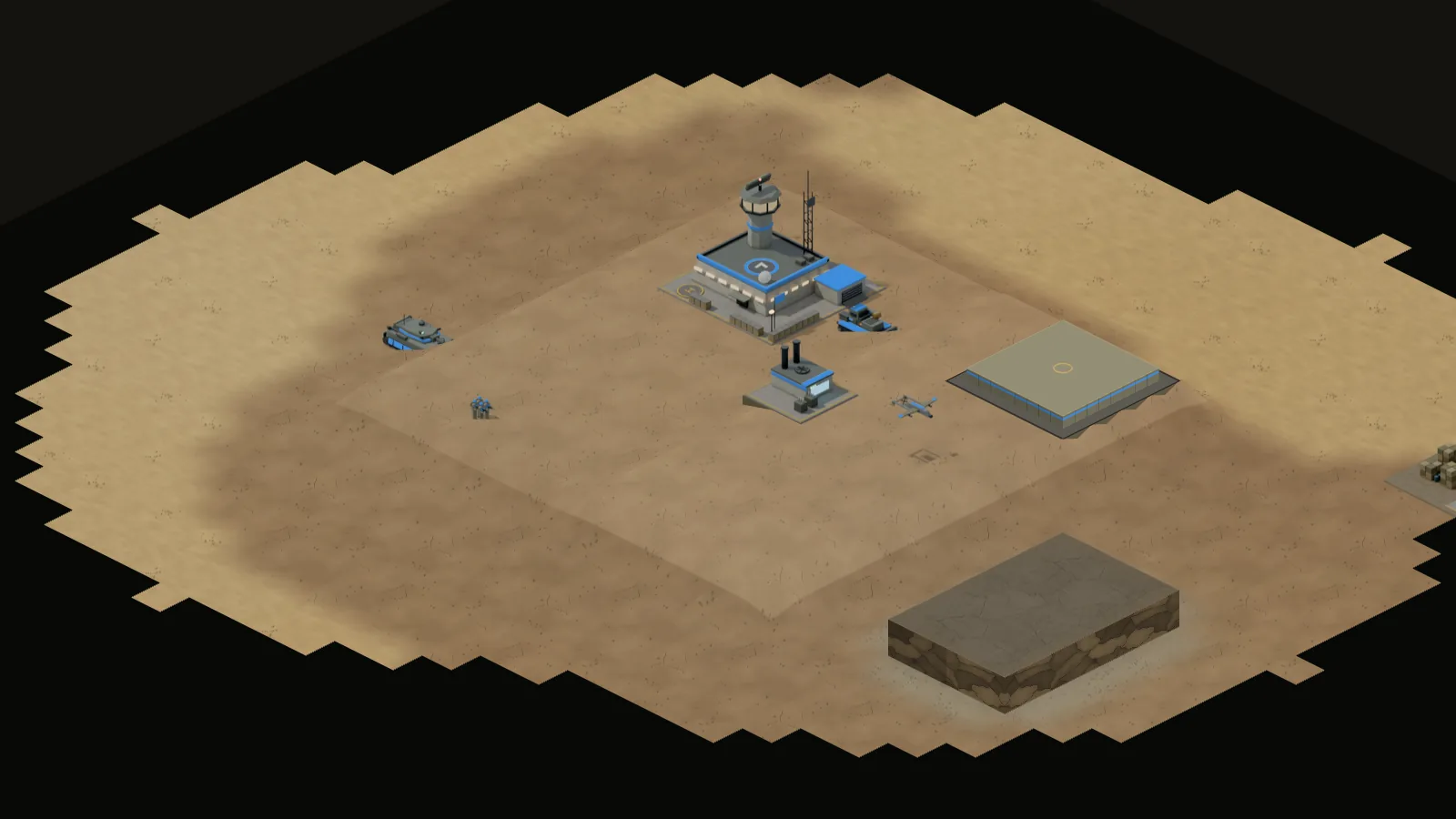
How it plays
Every rule here comes from the design document and the game's rules data. No hidden multipliers, no random rolls, and the same rules for players and AI.
- Simulation tick
- 0.05 s
- Arithmetic
- Fixed-point
- Random critical hits
- None
- Weapons in the rules
- 29
Economy
One currency, four distinct meters. Every faction starts with the same HQ, rig, 6,000 credits and 40 power, and mines at the same rate.
Credits
The only spendable currency. Paid when an order starts.
Power
Keeps buildings working. Run short and everything slows.
Army Supply
Caps army size at 100 per player. Not money.
Command Energy
Pays for support abilities. Regenerates from the HQ.
Cargo is not money
Credits reach your bank only on delivery. A destroyed hauler's cargo is lost to both sides.
Fields run dry
When every field is empty, a public 180-second timer drops a 6,000-credit shipment at the map's center.
Honest refunds
Cancelling refunds 75% of the remaining progress. Selling returns half the building's value, scaled by its health, after a five-second channel.
Nothing to buy
No paid advantages, no faction income bonuses, no kill-based income in standard matches.
Construction and power
Rigs build on visible ground inside your build radius. Power decides how fast everything else happens.
Build radius
Fourteen tiles from an HQ or outpost. Supply centers don't extend it, so cheap creeping-base chains don't work.
Foundations
Construction starts at 10% HP and grows. Damage taken during construction stays. Another rig can resume a paused job.
Low power
Construction, production, research and rearming run at half speed, and defenses fire half as often. Units fight normally.
Tech tiers
An active radar unlocks Tier 2. Radar plus a technology center unlocks Tier 3. Losing a prerequisite pauses work, never deletes it.
Visible caps
Sixty structures per player, sixteen of them weapon defenses. Foundations reserve their slot.
Nothing in the dark
No building inside unexplored or currently unseen territory.
All 20 buildings
Power with a plus sign is generated; other values are demand.
Orders and control
Classic RTS controls, every key remappable, with a left-click command preset. Orders are acknowledged within 100 ms; the server still decides what actually happens.
Move means move
Units go where you sent them and don't chase. Attack-move fights along the way, then continues.
Guard and hold
Guard engages within six tiles of its anchor, then returns. Hold never moves on its own.
Blocked orders say so
A unit stuck for two seconds re-routes. After two failures it shows a blocked marker and alerts you once.
Rejected orders explain
If the server refuses an order, you get the reason and the predicted marker reverts.
Combat
Damage is deterministic and readable. Facing and turret turn are visible behavior, never a hidden armor modifier.
Multipliers from the game's rules data. "No" means the weapon can't target that layer at all.
Cover
Infantry in marked cover take 25% less small-arms and autocannon damage. Artillery and air strikes ignore it.
Friendly fire
Shell and missile blasts hurt your own side at 50%. Ordinary direct fire never does.
Stacking limits
Only the strongest copy of a buff applies, and ability-based damage reduction caps at 30%.
Shots in flight
A projectile already fired still lands if its shooter dies. Artillery and missiles hit a ground point, not a moving unit.
Full weapon catalog
Fog and detection
You fight what you can see. Explored ground keeps last-seen buildings with timestamps; enemy armies vanish when sight is lost.
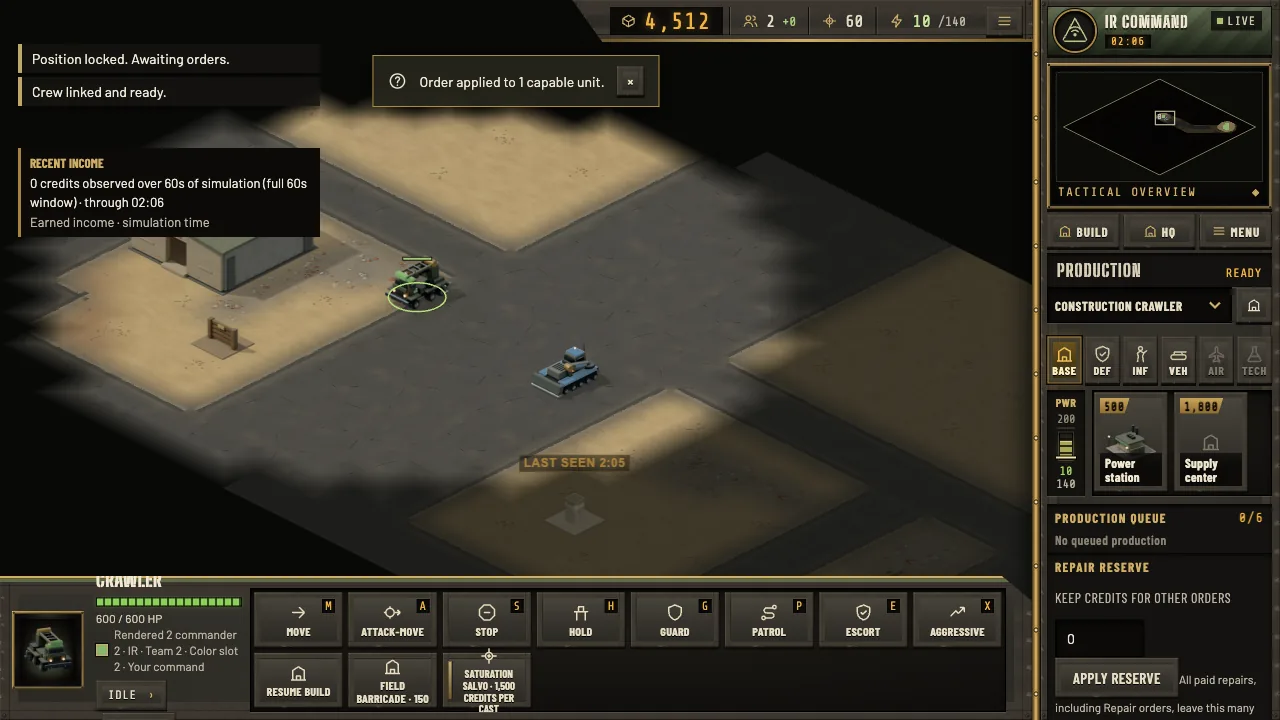
Earned vision in a local multiplayer test. The fogged building keeps its last-seen time; the units around it are not shown.
Air operations
Aircraft are powerful because they have to come home. Every plane or drone reserves a service slot, flies on a timer, and rearms on the ground.
Distinct air roles
Interceptors hit air only. Strike aircraft make ground passes and return when empty. Gunships and loiter drones hover until their magazine runs dry.
Rearming is free, repair is not
Rearm takes 18 to 24 seconds depending on role. Repair costs credits and runs in parallel.
Losing the airfield
Aircraft look for another free slot with at most 60 seconds of fuel left. Nothing is deleted instantly.
No forever sorties
Repeat attack runs need an explicit queued order or a repeat toggle. There is no hidden "ignore fuel" stance.
Missiles and interception
Tactical missiles hit hard, cost credits per shot, need earned vision, and always give the defender a warning and a choice.
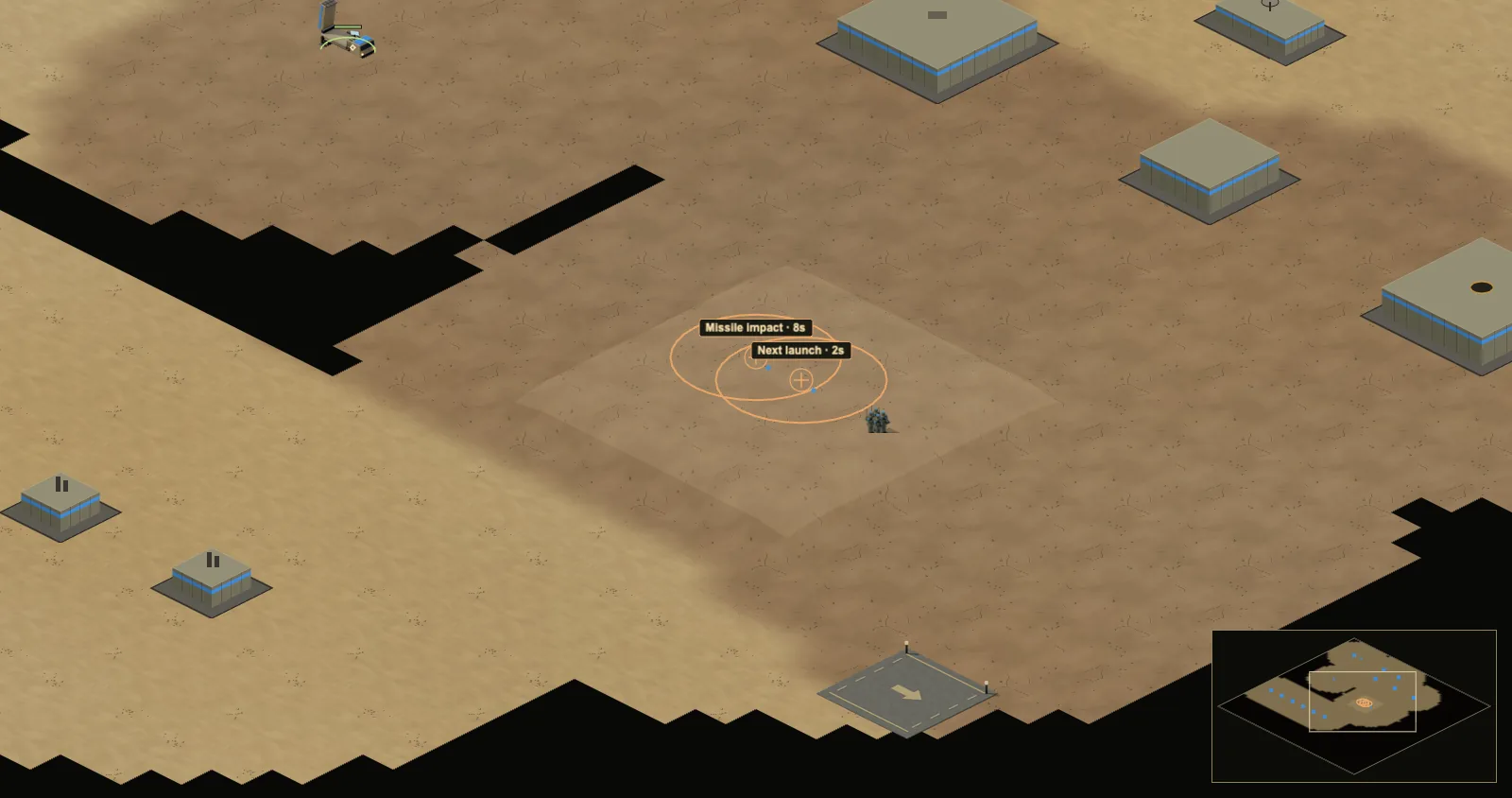
An Iranian banked volley as the defender sees it: each missile gets its own marked area and countdown.
| Launcher | Range | Charges | Recharge | Credits per shot | Max damage, structure |
|---|---|---|---|---|---|
| US and Saudi | 10-36 | 1 | 80 s | 400 | 500 |
| Iranian ballistic | 10-44 | 2 | 60 s each | 300 | 350 |
| Syrian heavy rocket | 8-28 | 1 | 65 s | 300 | 400 |
Setup is a commitment
Four still seconds to set up, three to pack. Launching reveals the launcher for six seconds.
Eight-second warning
Every missile gives at least eight seconds, a marked area and a voice and caption alert.
Interceptor batteries
Fourteen-tile coverage, two charges, one more every 24 powered seconds. One charge stops one missile. No percentages.
Separate layers
Ordinary AA shoots aircraft; interceptors shoot missiles. Neither stops artillery, bombs or tank shells.
Abilities and operations
Two kinds of big decision. Command abilities spend energy from your HQ. Strategic operations charge at one expensive site and cost credits to fire.
Everyone sees it charging
All players see each strategic site's faction and charge. Its exact position still has to be scouted.
No HQ one-shots
A full-health HQ survives the maximum damage of any strike operation, before interception.
Four different operations
Bombers, a missile salvo, a temporary raid and a defensive zone. Equal cooldowns don't imply equal power.
Failure costs nothing
A cast the server rejects spends no energy. Once accepted, cost and cooldown stay spent.
Repair, transport, capture
Keeping units alive is a real strategy. Mechanical repair costs one credit per ten HP and only works out of combat.
Transports
APCs carry three squads, troop technicals and helicopters two. Destroyed ground transports release passengers at half health; airborne ones don't.
Capture
Engineers take enemy buildings under 25% HP after eight uninterrupted seconds. HQs and strategic sites can't be captured.
Sabotage
Commandos disable a producer for ten seconds after a six-second channel. Damage interrupts it.
Garrisons
Bunkers and marked map buildings hold two squads that fire from inside at normal range.
Veterancy
Units earn experience from the value of enemy combat units they help destroy, split by actual damage dealt.
No self-healing or speed bonus. Buildings, friendly damage and temporary units award nothing, and healed damage can't be farmed for repeat rewards.
Victory and recovery
You lose when you have no HQ, barracks, factory, air producer or construction rig left, and a visible 30-second countdown runs out.
A way back
Lost your HQ? An owned factory can build an emergency rig for 1,200 credits, and it can found a new HQ anywhere visible.
No hiding forever
From minute 35, enemy headquarters and production buildings appear on the minimap for five seconds every 90 seconds.
Draws are real
Simultaneous elimination is a draw, decided from one simulation snapshot. A 90-minute safety limit also ends in a draw.
Surrender
Individual surrender eliminates only you. A team surrender needs every active teammate to agree.